
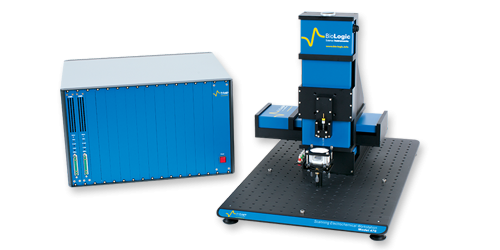

Description
The SECM470 module includes both Direct Current (dc)- and Alternating Current (ac)-SECM as standard
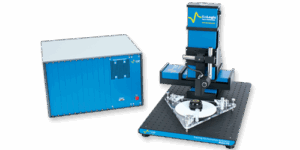
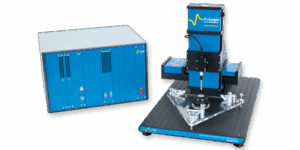
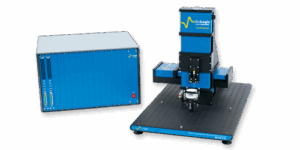
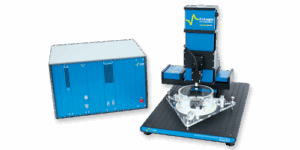
Perform constant height Scanning ElectroChemical Microscopy measurements on BioLogic’s modular M470 with the SECM470 option.
The most versatile scanning probe electrochemistry technique
Scanning Electrochemical Microscopy (SECM) is a scanning probe electrochemistry technique capable of measuring the activity of a sample with chemical selectivity. The versatility of SECM makes it the most popular technique in this family. The SECM470 module includes both Direct Current (dc)- and Alternating Current (ac)-SECM as standard to allow researchers the highest level of flexibility in their experiments. The SECM470 performs SECM measurements in the constant height mode. For constant distance SECM measurements the ic-SECM470 module should be considered.
SECM is one of the most widely applicable scanning probe electrochemistry techniques. It is used in materials research, for example to investigate the latest 2D materials and alloyed metals. In the field of catalysis SECM has been applied to the high throughput screening of new catalyst chemistries. Similar investigations have been performed in the field of biosensors. In the field of biology SECM has been used to measure samples ranging from single cells to plants. The use of SECM in battery research is growing with a wide range of applications including investigating the solid electrolyte interface, measuring solid state electrolytes, and measuring the reactions occurring at battery electrodes. SECM can even be used in place of bulk electrochemistry measurements to measure accurate electrochemical kinetics.
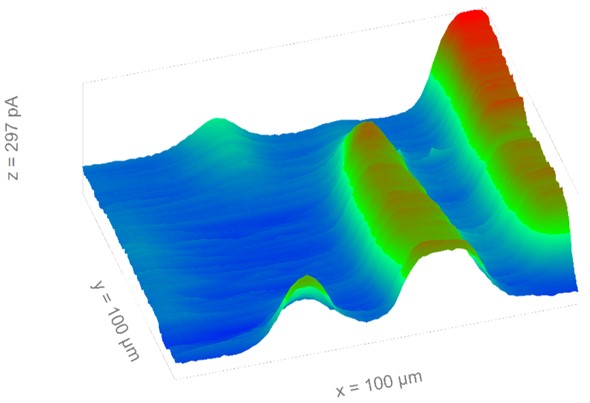
SECM measurement of living spider plant leaf in 0.1 mM KCl. 1 µm Pt probe biased at -0.75 V.
Overview: Versatile high-resolution mapping of sample activity
- Wide variety of accessories
- High resolution
- Unlike other scanning probe microscopies the use of a redox mediator means there is chemical selectivity in the measurement.
Investigate local activity without a redox mediator using the ac-SECM technique
The SECM470 includes both dc-SECM and ac-SECM as standard. Unlike dc-SECM, ac-SECM allows researchers to investigate the local activity of a surface without the need for a redox mediator, or electrolytic salt. This makes it a very powerful technique because measurements can be performed in a system closer to the real world. ac-SECM has found use in corrosion because it does not require the use of species which may inhibit, or accelerate the corrosion of a surface. It is used in biology because a system which is non-toxic to living cells can be used. ac-SECM can be particularly useful for systems where a suitable redox mediator is not clear, such as organic electrolytes.
Measure conductors, semi-conductors, and even insulators
Most scanning electrochemical measurements, and indeed some scanning probe microscopies, require a sample that is conducting or semiconducting. Furthermore, the sample must be connected to the electronics of the system. This limits the potential candidates for measurement. SECM, however, can be used to measure conducting, semiconducting, and even insulating samples, which do not need to be connected to the electronics of the system. Because SECM does not require the sample to be active it can be used to measure a wide range of sample types from living cells to corroding metals, giving it a range not available for other scanning electrochemical measurements.
Sweep scan or step scan SECM measurements
Using the SECM470 dc-SECM can be performed in both step and sweep scan mode. With sweep scan mode the probe is continually moving during the measurement, which makes it faster than using the step scan mode. By using a sweep scan it is possible to use the SECM470 to measure dynamic, changing samples.