
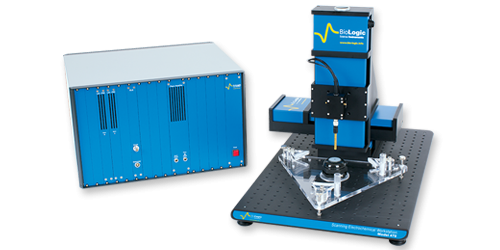

Description
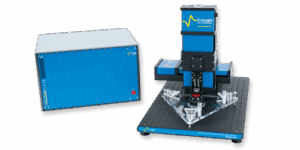
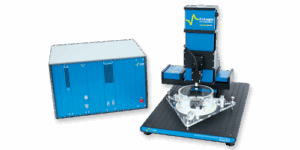
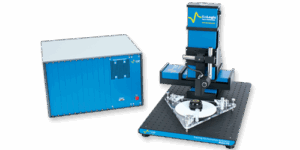
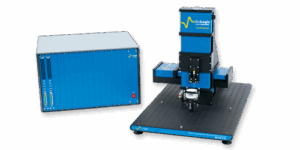
SKP – M470.
Technique uses a vibrating capacitance probe of known construction to measure the work function difference with the sample of interest
Map local work function changes at a sample surface
The Scanning Kelvin Probe (SKP) technique uses a vibrating capacitance probe of known construction to measure the work function difference with the sample of interest. By moving the probe in the x,y plane it is possible to map the local work function changes across the sample. This work function difference can be related to a characteristic of the surface condition including the corrosion potential. Using the same setup it is also possible to perform two different types of topography measurement: Capacitive Height Measurement (CHM) and Capacitive Tracking Measurement (CTM). CHM and CTM can be used as a standalone topography measurement, or as an input for a further height tracking measurement.
SKP has found widespread use in corrosion and coatings research. It is particularly useful for investigating the initiation of corrosion under a surface coating. The field of photovoltaics has seen growing use of SKP for determining the work function of different components. It has also been used as a means of detecting surface contamination of components. SKP has been proposed for use in biotechnology to measure the electrical potential of living tissue and has even found use in the field of forensics.

Constant distance SKP measurement of €2 coin performed in height tracking mode using the topography measurements from CTM.
Overview: Non-contact, non-destructive local work function measurements
- Non-destructive
- Can be used even when an insulating coating is present
Measure your sample without exposure to electrolyte
Exposing a sample to the electrolyte for extended periods can lead to sample damage. If the sample is at risk of corroding when exposed to electrolyte this also raises the possibility that the sample will be in a different state at the start and the end of the experiment. Unlike other scanning probe measurements, SKP is performed without any electrolyte present, while still providing electrochemical information about the sample. As a non-contact technique performed without electrolyte present, SKP is a truly non-destructive measurement.
Auto-tune capability allows for faster experimental setup
In SKP the probe is vibrated perpendicular to the sample to produce a sinusoidal ac current. This ac current is converted to a dc output by the Lock-In Amplifier (LIA) with the application of a demodulation signal. For the maximum dc signal the demodulation signal must be of the correct phase. Selecting the demodulation phase correctly can be a daunting task for the new user. The SKP470 removes the need to determine the demodulation phase with the addition of the Auto Tune capability. This makes the experimental setup easier and quicker. It also ensures the correct phase for the maximum dc signal is always selected.
Perform both constant height and constant distance measurements
The SKP470 allows researchers to perform SKP measurements in both constant height and constant distance modes. Performing measurements in constant height mode allows the fastest SKP measurements as the probe z position is not adjusted during the scan. The probe to sample distance, however, affects the quality and strength of the SKP signal, therefore it can be beneficial to keep the probe near the sample surface throughout the scan. In this case constant distance measurements through height tracking, where the probe z position changes, is the best choice.
Select from two different SKP topography techniques
The SKP470 offers two options to measure the topography input, using the SKP470 setup. This allows researchers to first perform a topography scan followed by a constant distance SKP measurement without the need to change probes or perform any further alignments. The two SKP470 topography measurements available are Capacitive Height Measurement (CHM) and Capacitive Tracking Measurement (CTM). In CHM the probe maintains a constant height throughout and the change in probe to sample distance is measured. It is useful for relatively flat samples, where a fast topography measurement is needed. In CTM the probe height changes throughout the measurement to maintain the same probe to sample distance throughout. This method is useful for very rough samples, and samples with large changes in topography.