
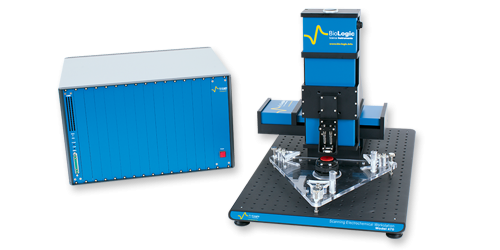

Description
ac/dc-SDS – M470 – Scanning droplet cell measurements for the M470
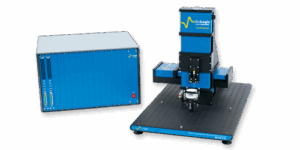
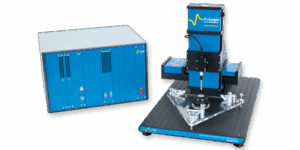
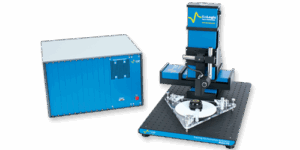
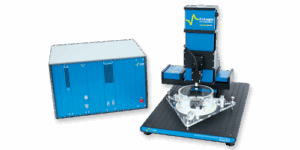
Perform Scanning Droplet Cell measurements on BioLogic’s modular M470 with the SDS470 option.
The Scanning Droplet System (SDS) performs Scanning Droplet Cell (SDC) measurements. In SDC measurements the probe is a droplet which moves across the sample surface in x and y. The sample acts as the working electrode in the measurement, while the reference and counter electrodes are contained within the SDC head. SDC performs direct local electrochemical measurements by confining the electrochemical cell to only the area in contact with the droplet cell. On the SDS470, the droplet cell is treated exactly as a bulk electrochemical cell, meaning any electrochemical measurement, including Electrochemical Impedance Spectroscopy (EIS), can be performed within this local cell. Furthermore, the SDS470 allows maps of the local electrochemical activity of a sample to be plotted.
Scanning droplet cell be used for any conducting or semi-conducting sample. Because the technique is based on a confined, local electrochemical cell, it has the potential for application in a wide variety of fields from sensors to catalysis. Scanning droplet cell has found use in materials measurements to investigate combinatorial libraries of the electrochemical properties of alloys of differing compositions. Scanning droplet cell is used in corrosion science. Of particular interest for these studies is the ability to refresh the electrolyte droplet. By changing the rate at which the droplet refreshes the effect of flow rate on corrosion has been investigated. SDC is also applicable in surface modification studies, allowing controlled sample lithography to occur.
Overview: Direct local electrochemical measurements
- Can be used with all electrochemical, corrosion, and EIS experiments
- Performs both dc-SDC and ac-SDC measurements as standard
Sample measurement without full exposure to electrolyte
Exposing an active sample to electrolyte for the duration of an experiment is not always desirable. For some samples this can mean that for long experiments the sample states, at the start and the end of the experiment, are completely different. SDC provides a method to perform local measurements on a sample, and measure x,y activity maps of a sample without full exposure to the electrolyte. In an SDC measurement, only the sample area under the droplet probe is exposed to electrolyte. Therefore researchers can be confident that each point of the sample measured is in the same initial state.
ac measurements as standard
Alternating Current (ac)-SDC is unique to the SDS470 system. All SDS470 systems come with the ability to run both dc-SDC and ac-SDC measurements as standard. Like dc-SDC, in ac-SDC the electrochemical cell is confined to the area contacted by the droplet. In an ac-SDC line or area scan an ac-current of known frequency is applied to the sample throughout the measurement. This provides truly local electrochemical impedance measurements, where the sample is probed directly on a local level. ac-SDC can allow for sharper images than possible with other local electrochemical impedance measurements because only the point of interest is measured at each point.
Full range of experiments available
SDC on the SDS470 system can perform a wide range of experiments as standard. Aside from the standard area and line scan experiments performed with a constant applied dc- or ac-bias it is also possible to use any of the full range of electrochemistry, corrosion, and electrochemical impedance measurements in the M470 software. This provides researchers with the ability to modify the experimental configuration to measure the information of interest in a local technique.